
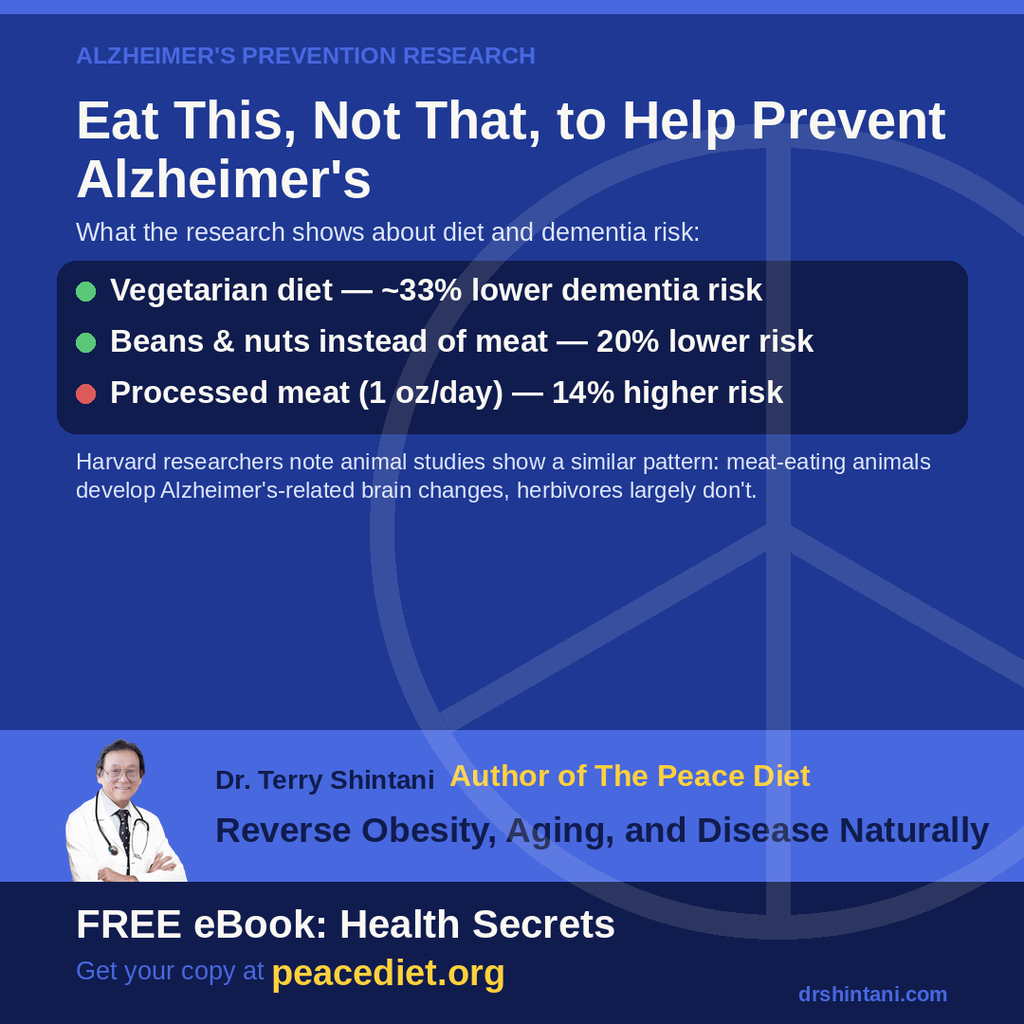
A striking observation from the animal kingdom may offer clues about preventing Alzheimer’s in humans. According to Dr. Terry Shintani, MD, a Harvard-trained physician and nutritionist, Dr. Rudolph Tanzi — chair of the Alzheimer’s research group at Harvard — has pointed out that meat-eating animals tend to develop Alzheimer’s-related brain pathology if they live long enough, while herbivores largely do not. (This specific observation is being confirmed with Dr. Shintani before a precise citation is added.)
While that observation comes from animal studies, recent human research points in the same direction.
Vegetarian diets and dementia risk
A 2022 study published in the journal Nutrients followed a cohort of Taiwanese adults and found that vegetarians had about a 33% lower risk of developing dementia compared to meat eaters.
Processed meat and dementia risk
A 2024 study presented at the Alzheimer’s Association International Conference found that eating about 1 ounce of processed meat per day was associated with a 14% higher risk of dementia, compared to eating very little processed meat. The same study found that replacing that ounce of processed meat with beans or nuts was associated with a 20% lower risk of dementia.
The takeaway
To help preserve brain function, consider eating less meat — particularly processed meat — and more plant-based foods like beans, nuts, and vegetables.
For more tips on brain health and longevity, get Dr. Shintani’s free eBook, Health Secrets, at peacediet.org.
Sources: Tsai et al., “Taiwanese Vegetarians Are Associated with Lower Dementia Risk,” Nutrients, 2022; 2024 Alzheimer’s Association International Conference — processed meat and dementia risk; NLM Native Voices