
Dairy has long been promoted as an essential, healthy part of a balanced diet. But a closer look at the research reveals some facts that are rarely mentioned.
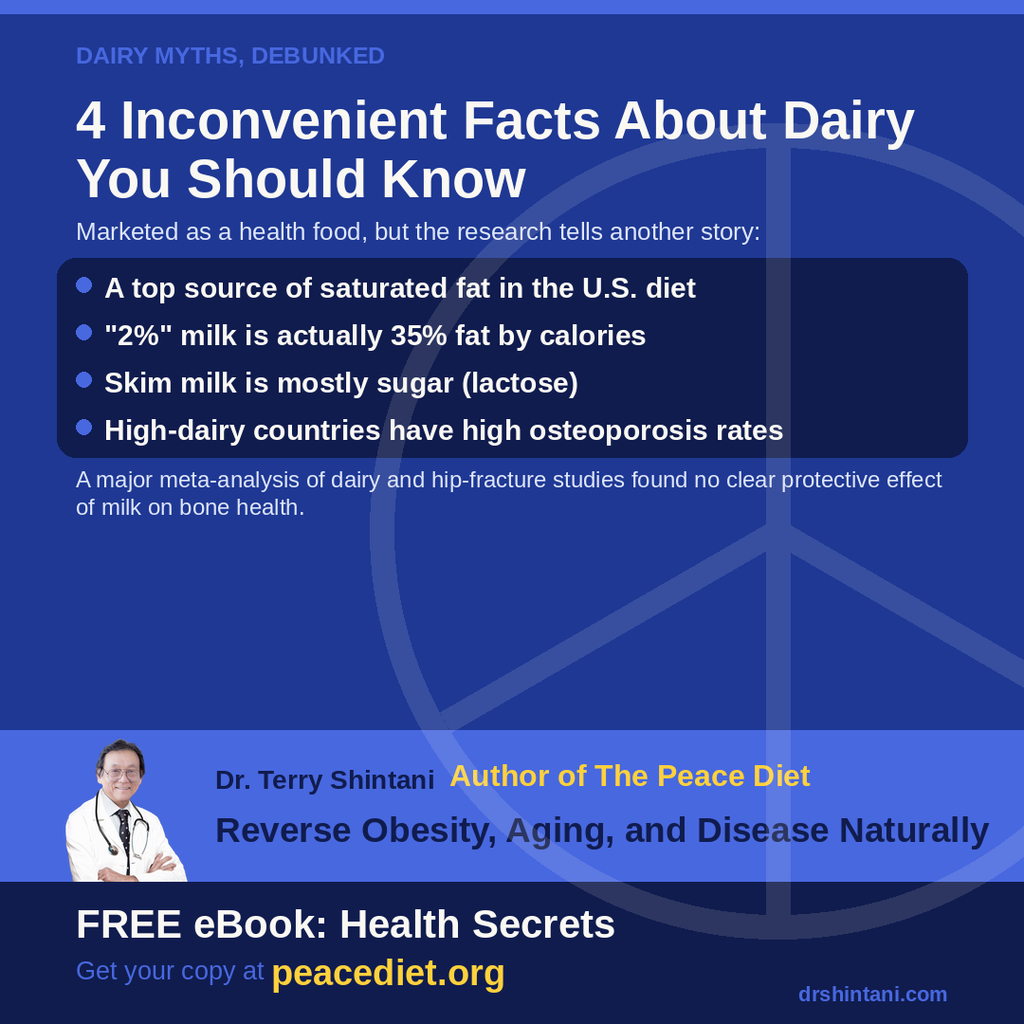
1. Dairy is a top source of saturated fat in the American diet.
The American Heart Association recommends limiting saturated fat to reduce cardiovascular disease risk. According to NHANES dietary data, cheese is actually the single largest food source of saturated fat in the U.S. diet, with beef second and milk fourth — but when dairy foods (cheese, milk, and other dairy products) are grouped together as a category, they represent one of the largest sources of saturated fat overall (PCRM analysis of NHANES data).
2. “2%” milk is actually about 35% fat.
The “2%” label refers to fat by weight, which is misleading since milk is mostly water. When measured by calories — the way your body actually uses energy — 2% milk is approximately 35% fat.
3. Skim milk is mostly sugar.
When the fat is removed from milk, what’s left is largely lactose, a natural milk sugar. By calorie content, skim milk is roughly half sugar.
4. Countries with the highest dairy consumption have some of the highest osteoporosis rates.
This is sometimes called the “calcium paradox” — populations in high-dairy-consuming countries (such as the U.S. and parts of Northern Europe) tend to have higher rates of osteoporosis and hip fracture than populations in countries with much lower dairy intake. This is a correlational pattern, not a controlled experiment, and other lifestyle factors (lifespan, activity levels, sun exposure) play a role too. But it’s notable that a systematic review and meta-analysis of dairy consumption and hip fracture risk, covering nearly 400,000 adults across 18 studies, found no statistically significant protective effect of milk against hip fracture (pooled relative risk 0.91, not significant) (PMC systematic review).
None of this means dairy has to be eliminated from everyone’s diet — but it’s worth knowing the fuller picture before assuming “dairy” automatically means “healthy.”
For more tips like this, get my free eBook, Health Secrets, at PeaceDiet.org.
I’m Dr. Shintani, for your health.
Sources & further reading:


